Daz 3D is part of 
Connect
DAZ Productions, Inc.
7533 S Center View Ct #4664
West Jordan, UT 84084
Licensing Agreement | Terms of Service | Privacy Policy | EULA
© 2026 Daz Productions Inc. All Rights Reserved.
Comments
...and Thank You for taking the time for such a wonderful reply to my rantings! :)
No need to thank me, it’s always nice to chat with like-minded folks.
_______________________________________________________________________________
It did not move, it did not glow, it made no sound. The ring segments stood motionless in the fog while, far below them, streams of data flowed, synchronized to the nanosecond.
I was one of the few who could read them.
Officially, I was a systems technician for phase stability. Unofficially, I was the one who stayed behind at night after everyone else had left. Not out of a sense of duty—but because the system was different when no one was watching.
In the third week of calibration, I noticed deviations. No errors, no outliers. Rather… repetitions. A pattern that didn’t belong to the environment. Too clean for noise, too precise for reflections.
It appeared only when the ring array was running in a specific configuration—a narrow beam, just below the ionospheric cutoff frequency.
I didn’t report it.
At first, I thought it was an artifact of my analysis. Then a bug. But the code was correct. The hardware stable. And the signal came back. Always at the same time. Always from the same direction. Not from space—but through it.
Woah!!!!
For the protection of highly sensitive facilities, an autonomous drone system is currently under development.
Its operational profile is clearly defined: any unauthorized approach to the designated security perimeter is automatically detected, assessed, and neutralized without delay.
Immediate obliteration is a wonderful form of security! :)
Or, as they say: the best defense is a good offense. Time to start rendering.
“AHD-X9 is not a hunter.
It is a boundary.”
Headquarters: Central Europe (not further specified)
Founded: 2032
Focus / Mission:
Development of autonomous protection and area-denial systems for critical infrastructure, high-security facilities, and military exclusion zones.
“AHD-X9 is not a hunter.
It is a boundary.”
Headquarters: Central Europe (not further specified)
Founded: 2032
Focus / Mission:
Development of autonomous protection and area-denial systems for critical infrastructure, high-security facilities, and military exclusion zones.
INFO_ https://www.bruder-aural.com/000-00_-thema_-cerberus-iii.html
_ Mannheim 18.01.2026
________________________________________________________________________________
2. Construction & Layout
Chassis
Central load-bearing unit with symmetrically arranged weapon and cooling system modules
Multi-layer composite structure (load-bearing frame + shielding + thermal protection)
Large internal volume to accommodate energy and cooling infrastructure
Modular Side Pods
Cylindrical high-performance modules on the left and right
Primarily house:
Microwave emitters
Cryogenic cooling systems
Energy buffers
Mechanical Architecture
Short, powerful joint segments
Designed for stability rather than speed
Center of gravity deliberately kept low
Absolutely Superb!
Thanks, Dartanbeck. The model will be further optimized later on; the chassis is still from the first generation. I’m still hoping that more people here who work with DAZ 3D will also give Hexagon a try. It’s so much fun to design and create your own assets.
Finally, I’ve found some time to build a sandbox where I can neatly sort all my figures and arrange them into groups.
The graffiti is also being systematically collected here and presented in a visually appealing way.
This will make it much easier to keep track later on, especially when certain individuals are specifically desired.
Railings as well as separate areas for clear group formation will be added later.
The sandbox is developing into an underground station. If necessary, I could mirror the whole thing and integrate the tracks.
Let’s see where it’s heading. The areas beneath the columns will become green spaces. Above that, we have daylight, which is ensured by the domes.
Update…
Just barely made the turn in time.
It’s staying a sandbox after all — the whole thing will become a playground where you can try out different things.
As always, everything is designed in a modular way and can be extended or swapped out.
The entire complex is 7.1 MB in size, so there’s plenty of room for content.
Now it’s time to move on…
______________________________ Update 000-01
Project Sandbox continues…
I’m currently working on the construction of the auxiliary building, which is designed to blend harmoniously into the overall project. As with the main building, I’m using rounded edges and a spacious terrace. This creates a welcoming area where visitors can relax with a cup of coffee and exchange ideas about the latest developments.
Inside the building, several conference rooms as well as retail spaces are planned, giving the auxiliary building both a functional and social role within the project.
For visualization, I’ve switched to Lumion. It serves as my first stop for reviewing projects and freely walking through them, allowing me to evaluate proportions, materials, and the overall atmosphere at an early stage.
Today, I spent two hours finishing the upper building, accompanied by some music.
The lower floor and the terrace are now being worked on.
Later, there will be 360° views where you can look around freely.
Next, I’ll move on to the other computer to view everything in Lumion and walk through it from a first-person perspective.
Everything worked out very well, and I am satisfied with the foundation.
It now serves as a solid base that can be expanded at any time through extensions and optimizations of the existing models.
Next, the work continues in Twinmotion.
I have already created some accessories, including street lighting and info points.
Unfortunately, one sandbox was lost due to the building, so I can now only work with two.
I had to reset everything because the scaling was incorrect. I took the opportunity to upgrade the version at the same time, this time including a small lake.
A bridge will also be added between the two buildings.
Love it!
Thanks for your comment. Here’s the current status:
I’ve just spoken with the city administration and arranged an appointment for the bulky waste pickup.
The floor lights have already been installed and only need to be textured. The building’s color scheme has also been enhanced with a bold touch of orange.
Looking exceptional! I love the pristine, I love the old... it all looks Fantastic!
Amazing that one person can keep this whole thing alive! Kudos! :)
Thank you for your perspective. For me, it is almost a matter of principle to continue using a tool as small yet remarkably efficient as Hexagon and to keep exploring its possibilities. Its strength lies precisely in its simplicity and focus.
I do not need an overloaded feature set or unnecessary technical distractions. What I am looking for is a pure modeling tool that concentrates entirely on the essentials, and that is exactly what Hexagon provides. It does not force complex workflows or constant context switching, but instead allows complete focus on form, topology, and the act of modeling itself.
In a time when software is becoming increasingly complex and multifunctional, I find this clarity refreshing. Hexagon is not an all-in-one solution, and that is precisely its value. For my purposes, it remains the right tool.
Bravo!
I agree. Someone who used to frequent the Carrara forum (Fifth Element) was a Silo user and he loved it for all those same reasons. The elegance of using software purity adds a particular charm and feel to how we work.
So I started watching Silo videos and eventually wish listed it. Then I asked myself why I would ever want to do that - I already have Hexagon. I never really used it because I was happy with Carrara, yet my using Carrara makes me feel pretty close to home when I launch Hexagon. As a modeler, I do believe that Hexagon wins.
And none of that really matters anyways, right? We use what we use because that's what we use.
As Dan pointed out, your work is exceptional and a great asset to the Hexagon community (assuming there is still much of a hexagon community apart from the 3 of us LOL). I for one would be interested in a master class from you, or even tutorials. I think with your background you have been able to easily adopt a workflow that has proven to be very successful in creating characters and environments.
Thanks for sharing the awesome adventure.
I may have to return to my roots of recreating everyday items in Hexagon. I did a few objects for some time then got distracted by the shiny new toys! LOL!
So taking your cue, I decided to model a 3.7v battery that was sitting o my desk. i have not done the material assignments for the label or contacts yet. But great to get back into it.
Hello Dartanbeck & Tugpsx
Thank you very much for your kind comments. I truly appreciate them.
At the moment I am working on several projects at the same time and I have noticed that I build very differently today compared to a few years ago.
More efficiently, faster, and in a way that keeps Hexagon stable and prevents crashes. If I find the time, I may go into some of these topics in more detail.
That said, I want to emphasize that there are many people here who create excellent work with Hexagon.
It made me especially happy to see that you also built something. I think that is great.
I also believe that we are still one of the few functioning communities, and we can be proud of that. Preserving old and proven tools so they are not forgotten is something truly valuable.
There are not many free tools available. Most alternatives are either extremely expensive, require a monthly subscription which I personally dislike very much, or are overly bloated. I only need a pure modeler, nothing more, and that is exactly what DAZ 3D Hexagon offers.
If DAZ were to fix the existing issues and add one or two improvements, I am sure that more people would switch to Hexagon again, especially for 3D printing.
With that in mind, I am looking forward to seeing more of your work.
The parking areas are currently being expanded. Charging stations have not yet been installed.
Note: The project is in construction mode; images shown are screenshots.
The Future of Parking – Intelligent, Contactless, Fully Automated
The system presented represents a new generation of automated parking solutions, setting new standards in comfort, efficiency, and technological sophistication. By utilizing state-of-the-art electromagnetics, precision rail technology, and intelligent control systems, it enables vehicles to be moved, stored, and retrieved fully automatically, without maneuvering, without stress, and without any loss of space.
In the driveway area, the user simply drives their vehicle onto an elegantly integrated platform. Electromagnets invisibly embedded in the ground cause a transport carriage to levitate a few centimeters above the surface. This contactless levitation enables virtually friction-free movement, minimal wear, and exceptionally smooth operation. The vehicle is securely and stably fixed on the platform throughout the process.
Here is an update to the Hexagon Power test. Are you UV editing in Hexagon? I think it may be easier to use mapper UVMapper Pro or i'll have to dust off my knowledge of UV Mapping process in Hexagon.
This turned out great....
I haven’t needed it yet since I do my texturing in Lumion or Twinmotion. However, I’ll be working with Substance 3D Painter soon; we have it installed on all our workstations.
After the mapping, how did you do the texturing? Do you use Photoshop?
Regarding your question: I don’t use mapping; I work with object groups. The battery, as you make it, would be five parts (five objects) for me. This way, I’m more flexible when rendering and can change the textures directly there and adjust them according to my needs.
Update / 30.01.2026
Thanks for you quick response. The model was assigned material zones in Hexagon, the materials were assigned colors or textures. The UV Mapping was adjusted for Y-Positive to align the material. Dartonbeck was a great resource for us working through this and getting the UVs correct since we both had not used Hexagon to this degree in awhile, we had to dust off the cobwebs.
I like your workflow and will continue refining my Hexagon skills.
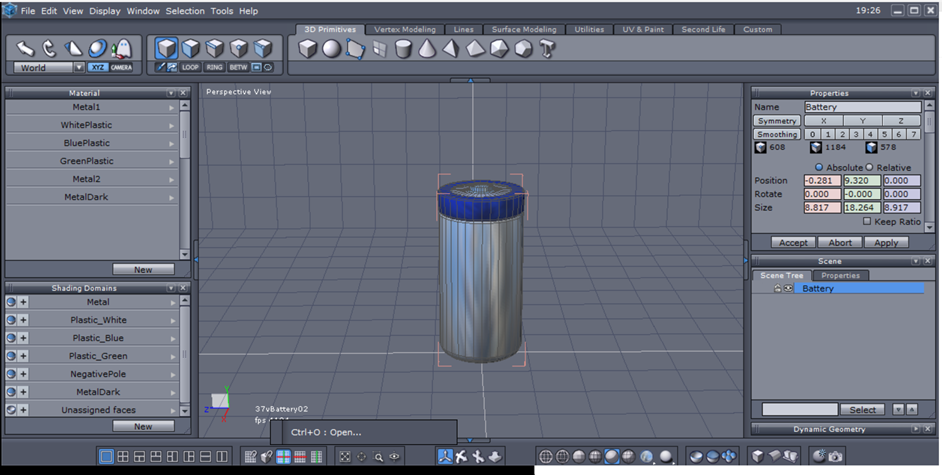
You are correct, it doesnt look too bad in Twinmotion