
Daz 3D is part of 
Connect
DAZ Productions, Inc.
7533 S Center View Ct #4664
West Jordan, UT 84084
Licensing Agreement | Terms of Service | Privacy Policy | EULA
© 2026 Daz Productions Inc. All Rights Reserved.
Comments
...well, memory pooling isn't be possible without NV Link and currently only the Quadro P100 is set up for it. If NVLink stays exclusive to the Quadro/Tesla line that would be more than enough to keep them marketable, epecially since they also can be used for straight compute purposes as well as deep learning for AI development. This is a huge game breaker as the ability to pool memory between GPU cards would open up so much more for graphics production, studios, film studios, and independent research labs, especially if (when) it is expanded to beyond a two way link (most likely through NVLink MBs).
Keep in mind, Quadros and Teslas also have different drivers geared towards industrial and scientific computing as well as are designed to withstand long duration operation at peak output while consumer cards are not.
This would allow Nvidia to the expand beyond the 12 GB limit for their high end consumer cards as even with HBM 2 memory, they most likely would not have NVLink compatibility, so there would be no memory pooling on the consumer level.
As to the CPU end, Intel sort of slipped up with their Skylake-X series, for instead of soldering the heat spreader to the Processor chip as they've done in the past, to keep the cost down they went to affixing it with thermal paste which doesn't dissipate heat as well.
NVLink can support up to 8 gpu's according to the white paper. The new Volta card has it too. Hopefully the Volta Titan will have it. That's the best I can hope.
I have two Titan Xp's. Why? Better performance and rendering (this especially). Plus, I'm in the process of designing my own games and they are, actually, the cheapest options. Quadros are a bit out of my price range.
...for the price of two XPs (particularly if they are water cooled) I could get a Quadro P5000 with 16 GB of memory. Granted not the greatest for gaming if one is also into that (which I am not) but for CG development and rendering much better as that iswhat it is specifically designed for and the extra 4 GB of VRAM can be mighty handy.
The 8 GPU NVLink is for systems that use NVLink cards.
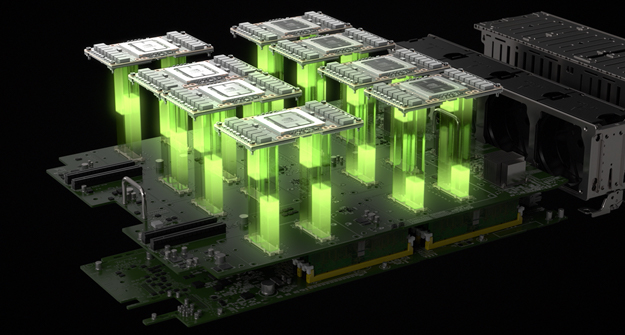
PCIe cards with NVLink (Currently only the GP100) are only designed for a two card setup.
"The 8 GPU NVLink is for systems that use NVLink card
Thanks for the clarification. Two should be good enough. Waiting for the Titan XV
Preach! :P
...hmm 128 GB of VRAM and 32,768 CUDA cores. Definitely "realtime" rendering.
C'mon Megabucks Lotto.
Nothing to add here, except that memory pooling on GPUs for IRay renders would be awesome, since you can already use all available cores. Now that they know how to do it in new cards, I wish they'd figure out how to do it in older cards, so you can mix and match (if you're not already) existing 3GB with 6GB with 12GB cards, because the used market is going to be flooded with deals.
As for the Titan X (Pascal), Titan Xp, and 1080ti, the Titan Xp is the renamed Titan X (Pascal). That's it: a name change. No other difference. Same specs, same price.
Quadro cards include a level of customer service not available with the GTX (gaming) series, so they could, in essence, simply sell the exact same card to both markets at the same time - Quadro for those who need the extra customer care e.g. custom drivers without all the extra stuff, and the GTX line for those who want to take their chances with the extra stuff and no support outside of the basic warranty.
Those who need the extra level of care will still pay for that willingly, because of the end-result. The rest of us will do what we've always done: complain about it on the internet and try the latest drivers or roll back to the last one that worked.
Not true! Educate yourself here: http://www.geeks3d.com/20170418/nvidia-titan-xp-vs-titan-x/
Actually the Titan XP was a response to the GTX1080ti, which had surpassed the original Titan X in performance. Nvidia couldn't allow their flagship consumer card to be outmatched so it opened all the cores in its GP102 GPU and renamed it the XP, thus restoring the Titan as the king of the hill.
..indeed. professional; studios have a lot at stake and need to ensure that they have not only the latest driver updates for the work they do, but can get the best troubleshooting if something goes wrong. Dowtime for them is lost money, sometimes a lot of of money. For us hobbyists and enthusiasts, it's just annoying and frustrating.
It's like paying for extended premium system support that's already "baked" into the hardware's price. Again Quadro and Tesla GPU cards are also engineered for heavy long term operations at peak output which would eventually fry a GTX card. Notice that for one thing, Quadro power requriements are lower than comparable GTX cards, which also reduces heat production. HBM 2 allows for even lower power consumption, as I mentioned about 50% that of GDDR5 (so AMD must be doing something else wrong in the design of their Vega Fronteir card for it to put out so much heat at peak load). Heat is one or the primary enemies of micro electronic components, the less heat stress, the better the reliability and longevity (this is why I never overclock). Sometimes the higher cost is well worth it for durability and peace of mind.
Remember the Yugo back in the 80s? 3,990$, cheaper than anything else on the road (not just in sticker price either as their construction was incredibly shoddy). In their test evaluation, Consumer Reports referred to it as the first "disposable car", and they were 100% correct.
As tothe Titan, there was a slight change to the Pascal Titan-X earlier this year as I mentioned above, when Nvidia unlocked the last two SMs giving it the full core count and floating point performance of the Quadro P6000, rebranding it as the Titan-Xp
There are still three key changes between the TITAN XP and Quadro P6000:
@DrNewcenstein
Unforunately there is no way to pool memory using NVLink on older cards.
On NVLink PCIe cards they have a new connector similar to an SLI bridge but wired differently. This connection links the memory with an extremely high bandwidth bus (Something like 80GB per second), An SLI bridge only needs to keep the cards synced up and working on drawing the same video frame at the same time (No processing or memory alocation tasks go across an SLI bridge). The PCIe bus is way too slow to handle NVLink data and does not directly link between card slots (The PCIe Lanes are direct routes to the CPU)
Well, shut my mouth and call me corn-pone. Thanks. I looked at the specs at Nvidia when the Xp name popped up, as I had already bought an "X (Pascal)" but didn't catch (or glossed over) the core count.
Now, how do I unlock the SMs on my Pascal to get all the cores? Can this be done with a command-line? Do I solder a jumper, or cut a pin or a trace? Could I load the bios of an Xp onto it and get it done? Inquisitive idots want to know!
Ah well, looks like they pulled a Base Genesis Figure and sheared them off with a laser. BIOS swap won't unlock what isn't there.
Honestly, the disabled cores where probably defective, or the chip wasn't good enough to handle full clock speed will 100% of the cores active. (When the TITAN X was new, the chip yield was probably not good enough to consistently pump out 100% perfect chips.)
The GP102 chip that's in your TITAN X is the same base chip as the GTX 1080 Ti, TITAN XP and Quadro P6000.
Yours was probably a "defective" Quadro P6000 chip.
Fast forward a year later: Perfect chip yield gets good enough to support the Quadro P6000 and TITAN XP demand, and use the defective ones for the GTX 1080 Ti.