

I checked out that liefeld link. Those drawings looked good to me! The dude reviewing was being way too literal. The drawings conveyed emotion quite powerfully. I would've never noticed the unrealistic 'problems' if they hadn't been pointed out or if I hadn't been searching for them. Liefeld nails the major emotion with each panel. I like the imperfections.
Yeah, as with all things, beauty is in the eye of the beholder. I don’t think hating on the guy is a healthy, constructive endeavor. If you don’t like his stuff, don’t read it and don’t use it as an example for your art. If I don’t like someone’s art, I don’t read their books.
Here's the fundamentals. Many of the artists around the time Image Comics became a thing were kinda jerks. (This is an understatement.) Primadonna syndrome. The reason people are always surprised to find out a famous person is also a nice person.
Now, bear in mind, the editors in the comics industry were, and still are famously jerks, so I'm not saying the aritist were wrong. I'm just saying they were arrogant and kinda jerks. Rob Liefeld was one of the worst of them.
When you make it a point to kinda be an ass, because you're rich and famous, people start looking at you with bit of eye jaundice. Dude was not a nice guy, is what I'm saying. In fact, among a cohort of people who would not earn the "I know he's famous, but he's really sweet," award Liefeld was both among the least likely to win that prize and the least talented artists.
And he seemed unaware of that. Which leads to people taking the piss out of you.
I never felt like Liefeld ever got the emotion right. That's not petulance. When he started on New Mutants, I thought it was okay, and my opinion sank from there. David Hasselhoff had a huge music career in Germany. There's someone who enjoys everything.
I didn't mention Liefeld just to take the piss out of him. I did it because dude had the kind of issues that divide people and hijack threads where folks debate stuff and try to take the piss out of each other. The kind of issues that ruin careers and he climbed to the top of the game... Because he started one step below the top.
Are you one step from six figures in web comic income (hint, if you are not already making around 95 grand a year, the answer is "no.")? Do you have a loyal following who cares nothing for your flaws and will sell their family members for a bit more cash to spend on you? More over, do you have an industry nemesis who draws as much hate as you do? If you didn't not answer yes to all of the above, Rob Liefeld is probably a bad role-model.
Actually learning the rules of art and design is a better direction to go.
Look at this way. Consider Liefeld. Consider Pixar's Incredibles. Why is one the butt of jokes, and the other seen as just fine? Pixar is following rules of character and caricature, in a mold made famous by Bruce Timm and his Batman the Animated Series style (later of Superman and Justice League fame). The men are over bulked, the women too pinched in places that would at lease impede digestion, if not worse.
But it is consistent. Liefeld's issues were often mistakes. (a famous Internet era example being a drawing Captain America holding his shield in a way that demand his arm be disturbingly tiny, yet rooted to massive delts bis and tris.)
Timm (and Pixar) know the rules well enough to break them. Liefeld doesn't care about the rules at all. Liefeld is a success. Timm and Pixar are bigger None of the three crawled up from the bottom to make their way. If you're reading this thread for tips, you can't afford to be like Rob.
Good posing is not about technical accuracy. Like any story form, it comes down to suspension of disbelief. This goes for narrative works as well as graphic. If something consistently looks awkward and wrong, it acts as a period in the middle. Of a sentence. That might work sparingly in avant garde, but it tires quickly when encountered scene after scene. It's no longer a fun device, but the sign of an amateur.
Shel Silverstein, one of the most successful cartoon satirists of the 20th century, had a fairly rough style that was often described as a collection of shaky squiggles. When he posed a character sometimes the proportions weren't exactly right. Yet he achieved a suspension of disblief and it didn't matter that you were looking at rough sketches drawn on the backs of napkins. The full effect of the suspension, especially in conjunction with the writing, allowed him cross-over success in everything from children's books to Playboy.
In action comics, the suspension of disblievef comes from the totality of the presentation. Everything is over the top. The foreshortened perspectives common in this artform would look aekward if used in a Cathy strip. There's a place for all of it, as long as it's sympathetically coordinated with the rest of the work.
A well-known feature of cartoon animation is the stretch-and-squash. You've seen in countless times: a character "warns" he's going to jump by first squashing himself down into a pysically impossible proportion. Then as he springs up, he stretches by 30-50% of his proper length. Disney has a favorite term for this: plausible impossible. From that the audience suspended their disbelief that taffy characters could be real, and simply. enjoyed the show. He was careful that Snow White herself (principally animated by a mentor of mine, Grim Natwick), didn's display a lot of stretch-and-squash. That wouldn't have been believable.
So we went from trashing his art, to THE REAL POINT IS, he's a jerk in real life too. lol
A few things
1) 3D art is not line and ink free drawing so using Rob Liefeld as any kind of example is far off the mark and not really helpful.
2) Most who work in 3D do not understand 3D as a medium and think 'the comic book' is the medium. That's why they try and mimic comic book styles and don't understand that 'artistic illustrative techniques' can still be employed using 3D tools.
It's just not done the same way and to the same effect.
3) We are judging a few 3D artists early (in their careers) verse "the best" in the actual comic field. Rather silly, then might as well go full tilt and say if your book ain't on Comixology, then sit down --> you're a hobbyist!
4) Without tradition and finer examples, new 3D artists are all still experimenting and learning as they go. There are no rules to follow so it's all guesswork.
---
Understanding the medium....
3D can save you from some headaches, like hands and such, but then you fight the bigger battle which is holding something. A hand holding something is the damn easiest thing to draw- especially fists. lol
Getting face shadows right is hard in comics- mostly everyone uses the shortcut, which is the face in half-shadow, no matter the light source or weather conditions....Daz - EVERYONE knows what a battle lighting can be...from dark renders to simply.... weird renders. lol
Bad proportions (not to worry in 3D as the figures got your back) is the same error as limbs and bits disappearing into objects/persons....[bad collision stuff]
Drawing bad expressions and rendering bad expressions....same thing.......
We, in 3D, got people floating...always an issue......
Breaking out the box requires pre-planning and art design. It requires page-level thinking and not panel by panel work.
If you just started out telling stories, you think scene by scene.
If you do 3D art, you need to study film and STOP looking at comic books as your only source of information and inspiration.
-------------------
And to be honest, if you want to make anything of this comic thing, you'd better get off the fact that you're a 3D artist and start being a story teller that works in 3D media.
The real bar is getting people to care, not to be impressed.
And you ain't gonna tell a good story worrying about the technical side of you art.
That's for would-be peers to obsess over and scrutinize.
We already had 1 authentic reader experience that gave you answer. He didn't notice the flaws, he was too busy reading the dang comic.
On top of that, I own a bunch of Rob's work (all those Marvel-esque superhero teams lol), bought it when the covers pulled me in. I own all the fist coupla issues of all of them.
I never kept buying them because the stories never grabbed me. None of those characters mattered. Flaws and all, they LOOKED cool as hell and they were almost always in ultra-action mode. Very exciting.
Very dynamic- but tiresome after a while. Who can really remember significant events or any PLOT worth revisiting? That's what was missing.
Your technical skill only needs to be good enough to NOT distract you from the story.
Most that are critical arent READING books, you're looking at them.
I was curious about the answer to OP's original question, so I did some research!
The short answer is:
No, probably not. If you want to make a living making comics, you're better off buying Clip Studio EX and learn to draw line art. This is also much lower overhead than buying DS content. And I say that as someone who makes a living selling DS content, and who definitely wants you to buy my stuff.
The long answer is:
There are many webcomics on Patreon that support their creators to different levels. All of the 3D ones I found were porn, and they were mostly lousy renders, too. I think the most lucrative of those was making $721 a month. You might be able to find a better one doing a bit more research.
On the other hand, I very quickly found a hand-drawn sci fi comic that looked somewhat niche but was earning $700 per page. The most lucrative comic on Patreon appears to be Saturday Morning Breakfast Cereal at around $7k a month (he's out ahead of the next runner up at $5k and change). This is a gag-a-day humor comic. In fact, of the top 10 creators in Patreon's Comics list, none are openly pornographic, though a couple deal with more adult themes than others (El Goonish Shive, for instance, is definitely not openly porn but it sure is a compendium of fetishes; Long Exposure has adult situations but is more of a romantic drama).
Theory:
I personally think it should be possible to create a 3D comic that is financially viable without just making porn. So why isn't anyone?
The answer, in my opinion, is actually writing, not artwork.
The 3d comics that I saw were not very well written, and the characters were interchangeable. Comics like Dinosaur Comics, XKCD, and Wondermark, all financially viable projects from what I've been able to find out, prove that it's not the artwork that sells a comic to begin with; it's the writing. Creators that have great writing ideas but can't draw don't go to 3d first, they go to simple line art and copy pasting because it's much faster.
So someone absolutey COULD make a financially viable 3d comic - but the writing has to be the thing. The writing has to come first.
Okay, so movies. You can choose your render size, and if you are doing sequential art, you should. As a rule, long an narrow is bad unless the subject is also long and narrow (Think Superman flying, Spider-Man doing the hold the web below the butt swing). Most comic activity is going to be square, which is better suited to Mobile and Infinte canvasing on mobile where the defaul assumes a tall narrow layout, not long narrow. This runs in coflict with desktop which is also long and narrow.
The comic page is closer to square, but more tall narrow than long narrow. A consideration for thos aiming to do dead tree.
Bottom line, it's not what most do when rendering the counts, it's the format they are aiming to output too. Given that on ignores mobile at their peril, and tryingto be all cinema framed all the time is going to seriously hurt you presentation with a hefty market.
Prolly the smartest way to go about it would be something of a liquid layout that actally changed the layout of you comic panels as the display size changed, but that would kinda strange.
Possily fun, too but I digress.
The senquential artist should be playing with the size of the frame at all times, but with purpose.
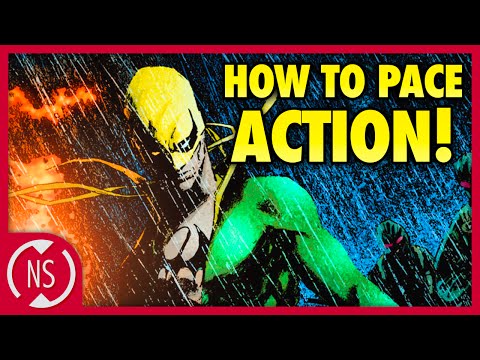
I owe someone a video. It happes that video makes this point, and make it well. No just because the subject is at play, but because the video author sets u the ideas with clips from The Avengers, which helps contrast the details that make comic pacing different.
And this does not go away with infinite canvas of single frame per page or something. So long as the action (be it a fight, a kiss or a discussion of interestes, it's all action) moves across the frame (and a long narrow frame always has movement, you have to show the reader where to start, which driection to go, and set them up for hard return across the screen, or (very experiementally) set them up to track backwards, compared to their last reading direction (it can be done, but it's not easy.)
Pay attention to what is stated about this pacing via stills in the video, and think about how much you give away when you decide that since Studio defalus to long and narrow, and movies are long an narrow, the 3D artist is defined by the aspect. It ain't so. That aspect should be used, instead, for effect, like the first frame of the Iron Fist fight discussed.
That long narrow shot surves a purpose. To impress Iron Fist into the reader's mind. But it serves another, because being big, and joining with the next two frames, it makes frame 4 seem to take a long time to happen. Which increases the reader's impression of how fast events on the rest of page are happening. Long narrow, all day every day can't really do that. It makes the things too regular. The very irregualrity of the frame sizes between 1 2 and 3 drives the sense of motion, with frame serving as puncation, and breathing room to help the read digest what they just say and place it context on a number of levels.
I could go on, but these points are the most effect rebut I can make, with video in tow. Comics have rules. Rules defined by their nature. You can't just ignore them and choose to use rules from movies on a lark. You have to understand what you are giving away. And you need to have in mind the media devices that will be consuming your media? PC? Lappy? Phone? Tablet? Dead Trees? Holography projected on the US Capitol Building? A laser stimulating the reader retinal with sRGB data one pixel and one color at a time, yet so fact the reader sees the whole image.
Subliminal Underwater basket weaving?
However the story is delievered, it changes the demands on the images, and changes the the demands on the image bounds and ratios. If all the comics are to be consumed on TVs and that new wrapparound gaming monitor, then assuming your frame, or page should be 16 by 9 might be the way to go. But mobile and tablets impose the vertical (we can't get users to turn the phones to get decent video. I doubt they'll really do it for your comic. I mean, they might once, but if that page doesn't slay them with the bad ass, they'll never come back. Over something as simple a 90 degree rotation), you must work with the vertical.
By the way, for those wanting the full run of videos, which I believe the above is the first of, wait a bit longer and I'll link a play list, or go to the video uploaders's page, click the channel search icon and search for "comicana"
For some reason, they don't seem to have those in their own playlist. :(
That video supports more my points more than yours.
They use a movie as the opening, the comic example is three tiers of approx 16X9 frames. Broken up, with one being broken and only have the white bars overlap the full scene.
The opening shots from The Avengers shows exactly what I said by camera angles. You see the close up of the conversation, jump cuts and also the WIDE SHOT of all the actors together.
The avengers represents a comic book onscreen- as also mimicked by Batman V Superman (sometimes shot for shot).
That is an EXACT example of 16 X 9 rendering. When you step back, which that comic page does not do is - present itself as an entire page. It goes expertly from frame to frame as opposed be being more of a sill that has the panels only hinted at- I'd expect someone to zoom out to see a full page or spread as they have always done. You're not doing that on a vertically held phone.
that's also a criticism of many books- is that they don't break out of boxes.
-----------
At any rate, we're talking comics, in a way so who's READING your comics on their phone?
They look to see the art and then they say "I'll check it out on any device where it's easier to zoom or I can actually read it.
What are all the normal aspect ratios? Only phones that aren't turned sideways are more vertical. C'mon now.
Yeah, the ONLINE comic, which is still what this thread is about- is not about mobile phones.
Who's still got a square monitor?
DC's books are now designed for the new media. What aspect ratios are they adopting?
Everything is pitching towards wider.
But again, who cares, if your advice is to study comics and such and whatever else, that's fine for us to have differing opinions about approach and execution.
I still think traditional dimesnions (i.e. tall pages, not film aspect ratio) sold on Kindle and Comixology are the best bet. If people are looking for other options, there's an app out there called MadeFire that makes the comic a bit more cinematic, allows you to add sound effects or dialogue, and basic animations. But if you're going to try out it, you're probably doubling your workload, at least in the beginning, because you have to learn how to use some new tools. And it's market is small.
There's still a place for print, and 3D comics can participate there as well, but the resolution needed for printing can be prohibitive. My projects are always 8 x 10 inches, for example, so that's 4800 by 6000 for 600 DPI artwork.
The only "advantage" an infinite page would have, that I can think of at least, is not controlling when reader's reach major reveals. Which to me is not an advantage. Page turns and cliffhangers go hand in hand.
Lastly, movies aren't comics. But I disagree that comic creators can't learn from movies or that filmmakers can't learn from comics. They're both primarily visual, so a lot of the basics are the same. I mean, screenplays aren't novels, or comic scripts for that matter, but there are storytelling rules that apply to all.
I think I brought up the Liefeld thing, and it was specifically a counterpoint to the notion that there is no such thing as bad art or that art has no rules.
I always just assumed he came from an alternate universe where women were, in fact, actually insects, thus why he seems to give them a pedicel connecting their thoraxes and abdomens.
Who knows what species the men are, but the women always looked really insectoid to me
I was going to bring up Bruce Timm and see if anyone wanted work out why he can do the thing, but... Meh. I've already surrendered. 2D mistakes are not relevant to 3D, or something.
The style in Batman TAS (and related) is much more stylized abstract its made up of simple shapes so it doesn't set off the same feeling (its basically the uncanny valley problem the more "realistic" something is the more off it feels when somethings not right)
And now as a Batman TAS fanboy I will point out that the pointed wasp waists didn't come in till the last season where they retooled and simplified the designs to make it easier for different animation houses to animate without going off model (although the worst change by far was the Joker's redesign... ugh)
I plan on starting a scifi comic sries, and later some others. I had started but I didn't like some of the renders and I wanted to redo the characters so I scrapped what I had and am going to start over. Mostly for fun, and hopefully to suplement my Daz addiction (thanks Daz...)
At any rate, when I'm laying out my scenes and have the dialogue going through my head, theat's exactly how I envision it, as a movie playing on the screen. It really helps me set camera angles, where and who to look at durring what point of the conversation, etc. It also helps me flush out the dialogue as I'm writing.
*edit*
there was also a scene in Birdman which really opened my eyes to writing a full story in a condensed space. In the movie, the play's writer had created a very emotional dialogue heavy scene. He ended up hiring a pro after problems with one of his actors and the pro looked at his lines and explained to him that the entire dialogue was just simply repeating itself in different words. The entire thing could be said in one line and still have the powerful impact the writer intended.
That video supports more my points more than yours.
They use a movie as the opening, the comic example is three tiers of approx 16X9 frames. Broken up, with one being broken and only have the white bars overlap the full scene.
The opening shots from The Avengers shows exactly what I said by camera angles. You see the close up of the conversation, jump cuts and also the WIDE SHOT of all the actors together.
The avengers represents a comic book onscreen- as also mimicked by Batman V Superman (sometimes shot for shot).
That is an EXACT example of 16 X 9 rendering. When you step back, which that comic page does not do is - present itself as an entire page. It goes expertly from frame to frame as opposed be being more of a sill that has the panels only hinted at- I'd expect someone to zoom out to see a full page or spread as they have always done. You're not doing that on a vertically held phone.
that's also a criticism of many books- is that they don't break out of boxes.
-----------
At any rate, we're talking comics, in a way so who's READING your comics on their phone?
They look to see the art and then they say "I'll check it out on any device where it's easier to zoom or I can actually read it.
What are all the normal aspect ratios? Only phones that aren't turned sideways are more vertical. C'mon now.
Yeah, the ONLINE comic, which is still what this thread is about- is not about mobile phones.
Who's still got a square monitor?
DC's books are now designed for the new media. What aspect ratios are they adopting?
Everything is pitching towards wider.
But again, who cares, if your advice is to study comics and such and whatever else, that's fine for us to have differing opinions about approach and execution.
Three points.
Mobile phones are the largest fraction of user internet devices. Most Internet access is mobile access. If you wish to do anything only, you have to consider how to do via mobile. Exceptions are monopoly tech like game consoles and multiplay PC stuff that mobile can't do. Displaying websites is not an exception.
Don't believe. Go to google news. Why would they reformat that site as a mobile site except that having a “fallback" for mobile no longer makes sense. Mobile is the majority, and all of the big players are adapting.
You said, “If you do 3D art, you need to study film and STOP looking at comic books as your only source of information and inspiration.” First, if you don't MASTER the concepts of comic story telling, you can't adapt other forms to it. You should never STOP looking at comics, whether as your only source or not. That's just poorly worded.
More over, movies have very little to teach the n00b, and this thread is mostly for the n00b. Anything they'd get from a movies they can get from a comic. You seal the argument by saying this move is a shot for shot of the comic (Watchmen is notably so). Scott Pilgrim also goes there.
What these films aren't doing is dumping a bunch of basics that aren't already in comics. Comics have all those low hanging fruit, which is why movies can be shot for shot remakes of comics.
To get more, the artist doesn't need to look at movies. They need to enroll in filmschool. Because it's beyond what you get watching for ideas, You need a grounding theory. Most people looking around here haven't grounded theory of comics yet. Movies is premature, You say 3D renders wide, so go film. This is your logic. But comics are about the means they are conveyed. The artist needs to learn to control their frame size more than they need to think deeply about keen rack focus. And again, anything they can find in film, they can find in comics.
Finally, Who cares? Well,first, you. If you didn't care, you wouldn't have replied about being right, before declaring the subject of dubious care. So yeah. You care. Also caring: Me. Shocker that. So, that's who cares.
Because I know for a fact, when I stop caring, I stop commenting. No motive due to lack of care. We're both posting. Ergo we both care. At this point you may switch to only caring to prove you don't care, but that's still care. In my experience, it sometimes useful to declare lack of care, because it explains something else. But it's always pointless to try to prove it. Because if you've reached the point where it's a point to prove, you've reached an item you can't argue. I usually cease all care shortly after that. The only way to make the point that you really don't care, is to not to try to make point at all. Which is easy, because if you don't care, you don't care to prove you dont care.
(Bonus fourth point. Yes they use a movie, because comics. If the movie was meant to be informative and instctional, they probably would have gone with a well known movies known for its plot. Instead it was popular comic movie chosen likely because people into comics would have seen it, thus helping brigde attention-and goodwill by transference-into the comic based section of the vid. In other words, he used the clips to manipulate you in a way not unlike that he's points out in the analysis. He doen't use the clips to show us anything about how to make comics, though.)
Well, books hang even lower than that. More movies are re-made from books than (comic)books.
The point isn't the comic format or look, even - the point is the familiar STORY. They are remaking, not the comics, but the stories and story arcs.
Does that make sense? So the look (and maybe even the layout) of the comic is almost arbitrary.
Some hyper-real, some stylized, some cell shaded, some manga influenced.
So really, there are exceptions for every look. Someone named the Simpsons, so there's no need to disappear up the 'doesn't look perfect' tree or even worry about the valley.
Comics also run the extremes. When the writer leads, you get massive amount of white bubbles and tons of text with the pictures, basically serving as the backdrop to epic speeches. When the illustrator leads, you get lots of pictures with cliche dialogue. I remeber my first comic(s). Everyone yelled and when someone pointed it out, I said, if it wasn't worth yelling, it wasn't important enough to say.
If you read a book on creating comic books and one on cinematography, you'll see a lot of the same concepts - framing, pacing, using backgrounds/locations, etc. Sure film has audio and motion while comics have (less intrusive) exposition and visual shortcuts, but a lot of the principles are the same. I'd recommend reading some articles on cinematography to get better at making comics.
Personally, I think that formatting things for regular books is still the best way to go. 1) You might get good enough to sell print copies. 2) Even if you don't sell physical media, you may sell .pdf collections of your works, and book sizes are easier for that as well. 3) Most people still grow up with books so they're used to that format. 4) Book pages are easier to duplicate on the web. You can easily do one page per web page. 5) A lot of people have multiple things open on their screen at once. Just because they can go 1920 pixels wide with their browser doesn't mean they will. They might have 2 browsers open, each taking up half the screen, one app plus a browser, etc. (I have two monitors and I still split the screen some times on each monitor.) 6) You can always make a web page that's equal to 2 book pages if you want to do the wide format.
On artwork - a lot of Poser/Daz Studio comics are looked down upon because, frankly, they're not very good. Default lighting, boring camera angles and just enough uncanny valley to be disturbing. They're like a comic book done with slightly out of focus and/or badly exposed photographs with word balloons tacked on. This isn't to say there aren't good ones out there, but most of them have been heavily worked to create a visual style that comes across as more than just a quick render per panel.
I like stylized artwork, but it has to have logic and consistancy. To me, divamakeup's artwork is good because it's clean, smooth, and has logic to it. It looks like the artist knows proper proportions, color, outlining, etc., but chose to exagerate features commonly emphasized for female characters. On the other hand, Liefield's art looks like he made it up as he went along - especially with the weird lines on faces, ridiculously tiny feet, etc. I can see giving female characters small feet if you're trying to emphasize daintiness but it makes no sense on hugely muscle-bound he-men. (Unless you're making snide jokes about the size of other parts of their anatomy.)
Like Sickleyield mentioned, the writing in a comic makes a huge difference. Some of the most beloved comics have "primitive" artwork like XKCD, Order of the Stick, and Saturday Morning Breakfast Cereal. The thing is, they're so smart, so fun, that they're worth coming back to over and over again. If you have a compelling enough story, people will not care as much about the artwork so long as it's not outright terrible. On the other hand, I've seen plenty of sites with page after page of gorgeous artwork that are so lacking in story that I never remember to check back because I can only stand so many pages of vacuous pin ups before I'm bored.
One last thing to consider - some comic book sites don't profit directly off their artwork but on their associated merchandice, such as t-shirts, signed prints, plushies, etc.
Ultimately, if you really want to be able to support yourself with your comic, you have to treat it as a business. Get critiques from people you trust to give you fair and honest criticism. Read up on both the artistic (artwork and writing) and business considerations. Do market research - analyze the sites that are succeeding and compare them to some sites that are failing and apply the lessons to your own work. Learn about web site design and SEO - or hire someone who knows how to do those well. Read up on branding and how to get the word out about your site. As with everything else, it takes work to make money.
Exactly, thank you! I approached it as a businessperson. My research said that the bottom dropped out of the tee shirt merchandise market in 2008 and that advertising is rapidly becoming unprofitable as well, so I looked around for what was profitable, and that's how I hit on Patreon. Patreon puts the artist directly in contact with their market, and more useful for our purposes, they basically publish exactly how much each artist is making. Maybe selling comics on Amazon is also a viable way to make a living, but I don't have data on those people's incomes.
Many of these Patreon artists actually offer the comic for free on their own site even though they're supported through Patreon. There are a few who only show the comic to their Patreon supporters, or who offer bonus incentives. Both of these seem to be viable models, even though one would think the free content model would result in less support.
I think the OP should try to write a comic that they actually like and not worry about a market. It's going to be the OP's best shot and if they fail they had fun.
Anyone can do that. I've done it myself occasionally, and it can be very fun. But that wasn't the question that was asked, OP asked about making a living. If you want to make commercial art and have that be your job, you have to treat it as a business.
I think the OP should try to write a comic that they actually like and not worry about a market. It's going to be the OP's best shot and if they fail they had fun.
Anyone can do that. I've done it myself occasionally, and it can be very fun. But that wasn't the question that was asked, OP asked about making a living. If you want to make commercial art and have that be your job, you have to treat it as a business.
So you are saying what? The OP should go off with a portfolio of art they didn't enjoy creating but choose to create to pander to some unknown people who more or may not sponsor the OP for the art they didn't enjoy creating on Patreon or elsewhere? Anyone can do that too and still not make a living and not enjoy what they are doing while they are at it.
I think the OP should try to write a comic that they actually like and not worry about a market. It's going to be the OP's best shot and if they fail they had fun.
Anyone can do that. I've done it myself occasionally, and it can be very fun. But that wasn't the question that was asked, OP asked about making a living. If you want to make commercial art and have that be your job, you have to treat it as a business.
So you are saying what? The OP should go off with a portfolio of art they didn't enjoy creating but choose to create to pander to some unknown people who more or may not sponsor the OP for the art they didn't enjoy creating on Patreon or elsewhere? Anyone can do that too and still not make a living and not enjoy what they are doing while they are at it.
I think the OP should try to write a comic that they actually like and not worry about a market. It's going to be the OP's best shot and if they fail they had fun.
Anyone can do that. I've done it myself occasionally, and it can be very fun. But that wasn't the question that was asked, OP asked about making a living. If you want to make commercial art and have that be your job, you have to treat it as a business.
So you are saying what? The OP should go off with a portfolio of art they didn't enjoy creating but choose to create to pander to some unknown people who more or may not sponsor the OP for the art they didn't enjoy creating on Patreon or elsewhere? Anyone can do that too and still not make a living and not enjoy what they are doing while they are at it.
I think the OP should try to write a comic that they actually like and not worry about a market. It's going to be the OP's best shot and if they fail they had fun.
Anyone can do that. I've done it myself occasionally, and it can be very fun. But that wasn't the question that was asked, OP asked about making a living. If you want to make commercial art and have that be your job, you have to treat it as a business.
So you are saying what? The OP should go off with a portfolio of art they didn't enjoy creating but choose to create to pander to some unknown people who more or may not sponsor the OP for the art they didn't enjoy creating on Patreon or elsewhere? Anyone can do that too and still not make a living and not enjoy what they are doing while they are at it.
Good luck with that.
Actually I like my job very much, and it pays rather well.
When you make commercial art, there is always a compromise between what is most fun and what is marketable. I never make products I hate. But I also can't make only things I love because there is limited market.
What I'm saying is that if you have several ideas for making a comic you might enjoy, maybe glance around and see if one is just like something someone established is already doing, one is too niche, one is in a popular genre but is a new take on it, etc., and pick something you like that other people will also like instead of a comic that caters to a minority fetish or something (I pick that because there's a lot of it around).
Let's not do the thing where everyone's point is taken to extremes. We'll all be basically "right" if the points arent exaggerated. The OP said decent money, not even a living.
Your 3D comic isn't a product as so much a property. Or a license if you will.
There's a million ways to make some coin, but none if it sits on a hard rive and waits on committee approval.
There needs to be balance.
as Stan Lee said ~ make something you really like and there are bound to be many others that like it too.
Do the business part, which is prensenting it in a sellable way or an easy to buy way, er so to speak. lol
I think the OP should try to write a comic that they actually like and not worry about a market. It's going to be the OP's best shot and if they fail they had fun.
Anyone can do that. I've done it myself occasionally, and it can be very fun. But that wasn't the question that was asked, OP asked about making a living. If you want to make commercial art and have that be your job, you have to treat it as a business.
So you are saying what? The OP should go off with a portfolio of art they didn't enjoy creating but choose to create to pander to some unknown people who more or may not sponsor the OP for the art they didn't enjoy creating on Patreon or elsewhere? Anyone can do that too and still not make a living and not enjoy what they are doing while they are at it.
I think the OP should try to write a comic that they actually like and not worry about a market. It's going to be the OP's best shot and if they fail they had fun.
Anyone can do that. I've done it myself occasionally, and it can be very fun. But that wasn't the question that was asked, OP asked about making a living. If you want to make commercial art and have that be your job, you have to treat it as a business.
So you are saying what? The OP should go off with a portfolio of art they didn't enjoy creating but choose to create to pander to some unknown people who more or may not sponsor the OP for the art they didn't enjoy creating on Patreon or elsewhere? Anyone can do that too and still not make a living and not enjoy what they are doing while they are at it.
Good luck with that.
lol Ummm That's not what she said ...at all.
Well, where did I tell the OP NOT to make a living at art? OP has already said the earn a living as professional artist. The know what treating it as a business means.
You did say "do what you love," and then argued by implication that doing anything other than that was misery.
The Freelancer take jobs as can. There was an author who got into an exclusive deal with publishing house, and then said house decided no to publush sustainably fast. Their feeling being if they put too many books out with the author's name, the books would undercut each others. The contract was genera exclusive SciF i and similar. So they could write other kind of fiction. Just not that one. Or anything too like that one. So they wrote a work of Fanstasy instead of the prohibited Scifi. (Except it was clearly a bit of Scifi with numbers rubbed off, and you can actually sense the writer's unhappiness trying to pass for fantasy). I'm sre the author enjody the books to an extent, they kept at it even after the legal restriction were relaxed, but the over all impression of the first is that it took a great deal of effort to get over the fact that it was "fantasy" and not scifi. He found a means to at least sort of enjoy the fantasy books. Maybe even overcome his own resistance entirely.
If you make business doing the exact thing you love right now, it could become a trap. David Weber meant to kill of the Protagonitst a long runny series (Inspired by Horatio Hornblower, the character was, nonetheless, model on Horatio Nelson and meant to meet the same end). Don't know if it was fan grumbling or publisher pressure but it never happened. I suspect Weber might have grown restive if he didn't have broad base of projects to work on.
The bottom line question is what is the motivation. "Create and deliver A comic," or, "Create and deliver this comic." The former provides more options. The latter more risk. both are valid ways to do it.
This aligns with publishing examples above. a choice between publishing something less than favorite, opposed to something unwanted nothing. But the fnamental answer to the OP's question is not no, but hell no. The comic would be luck if it paid for itself. so one is expected to seek to build an arrary of products. Or something. It's just flexibility, rather than singing on to hate work.
And to be honest, if you want to make anything of this comic thing, you'd better get off the fact that you're a 3D artist and start being a story teller that works in 3D media.
The real bar is getting people to care, not to be impressed.
And you ain't gonna tell a good story worrying about the technical side of you art.
That's for would-be peers to obsess over and scrutinize.
We already had 1 authentic reader experience that gave you answer. He didn't notice the flaws, he was too busy reading the dang comic.
Your technical skill only needs to be good enough to NOT distract you from the story.
Most that are critical arent READING books, you're looking at them.
So much good stuff in one comment!
One place where you are spot-on is that people aren't looking at the art, they're reading the story!
I used to leave Easter Eggs in my panels, and no one ever saw them. In one scene, I had a white mouse sitting on the speaker's shoulder, and no one noticed it! Not even when she reached up and picked it off
with her hand and set it on the desk!
Single images are for the art, comics are for the story. The visible art is the carrier for the story.
Comments
I checked out that liefeld link. Those drawings looked good to me! The dude reviewing was being way too literal. The drawings conveyed emotion quite powerfully. I would've never noticed the unrealistic 'problems' if they hadn't been pointed out or if I hadn't been searching for them. Liefeld nails the major emotion with each panel. I like the imperfections.
Yeah, as with all things, beauty is in the eye of the beholder. I don’t think hating on the guy is a healthy, constructive endeavor. If you don’t like his stuff, don’t read it and don’t use it as an example for your art. If I don’t like someone’s art, I don’t read their books.
Here's the fundamentals. Many of the artists around the time Image Comics became a thing were kinda jerks. (This is an understatement.) Primadonna syndrome. The reason people are always surprised to find out a famous person is also a nice person.
Now, bear in mind, the editors in the comics industry were, and still are famously jerks, so I'm not saying the aritist were wrong. I'm just saying they were arrogant and kinda jerks. Rob Liefeld was one of the worst of them.
When you make it a point to kinda be an ass, because you're rich and famous, people start looking at you with bit of eye jaundice. Dude was not a nice guy, is what I'm saying. In fact, among a cohort of people who would not earn the "I know he's famous, but he's really sweet," award Liefeld was both among the least likely to win that prize and the least talented artists.
And he seemed unaware of that. Which leads to people taking the piss out of you.
I never felt like Liefeld ever got the emotion right. That's not petulance. When he started on New Mutants, I thought it was okay, and my opinion sank from there. David Hasselhoff had a huge music career in Germany. There's someone who enjoys everything.
I didn't mention Liefeld just to take the piss out of him. I did it because dude had the kind of issues that divide people and hijack threads where folks debate stuff and try to take the piss out of each other. The kind of issues that ruin careers and he climbed to the top of the game... Because he started one step below the top.
Are you one step from six figures in web comic income (hint, if you are not already making around 95 grand a year, the answer is "no.")? Do you have a loyal following who cares nothing for your flaws and will sell their family members for a bit more cash to spend on you? More over, do you have an industry nemesis who draws as much hate as you do? If you didn't not answer yes to all of the above, Rob Liefeld is probably a bad role-model.
Actually learning the rules of art and design is a better direction to go.
Look at this way. Consider Liefeld. Consider Pixar's Incredibles. Why is one the butt of jokes, and the other seen as just fine? Pixar is following rules of character and caricature, in a mold made famous by Bruce Timm and his Batman the Animated Series style (later of Superman and Justice League fame). The men are over bulked, the women too pinched in places that would at lease impede digestion, if not worse.
But it is consistent. Liefeld's issues were often mistakes. (a famous Internet era example being a drawing Captain America holding his shield in a way that demand his arm be disturbingly tiny, yet rooted to massive delts bis and tris.)
Timm (and Pixar) know the rules well enough to break them. Liefeld doesn't care about the rules at all. Liefeld is a success. Timm and Pixar are bigger None of the three crawled up from the bottom to make their way. If you're reading this thread for tips, you can't afford to be like Rob.
Good posing is not about technical accuracy. Like any story form, it comes down to suspension of disbelief. This goes for narrative works as well as graphic. If something consistently looks awkward and wrong, it acts as a period in the middle. Of a sentence. That might work sparingly in avant garde, but it tires quickly when encountered scene after scene. It's no longer a fun device, but the sign of an amateur.
Shel Silverstein, one of the most successful cartoon satirists of the 20th century, had a fairly rough style that was often described as a collection of shaky squiggles. When he posed a character sometimes the proportions weren't exactly right. Yet he achieved a suspension of disblief and it didn't matter that you were looking at rough sketches drawn on the backs of napkins. The full effect of the suspension, especially in conjunction with the writing, allowed him cross-over success in everything from children's books to Playboy.
In action comics, the suspension of disblievef comes from the totality of the presentation. Everything is over the top. The foreshortened perspectives common in this artform would look aekward if used in a Cathy strip. There's a place for all of it, as long as it's sympathetically coordinated with the rest of the work.
A well-known feature of cartoon animation is the stretch-and-squash. You've seen in countless times: a character "warns" he's going to jump by first squashing himself down into a pysically impossible proportion. Then as he springs up, he stretches by 30-50% of his proper length. Disney has a favorite term for this: plausible impossible. From that the audience suspended their disbelief that taffy characters could be real, and simply. enjoyed the show. He was careful that Snow White herself (principally animated by a mentor of mine, Grim Natwick), didn's display a lot of stretch-and-squash. That wouldn't have been believable.
So we went from trashing his art, to THE REAL POINT IS, he's a jerk in real life too. lol
A few things
1) 3D art is not line and ink free drawing so using Rob Liefeld as any kind of example is far off the mark and not really helpful.
2) Most who work in 3D do not understand 3D as a medium and think 'the comic book' is the medium. That's why they try and mimic comic book styles and don't understand that 'artistic illustrative techniques' can still be employed using 3D tools.
It's just not done the same way and to the same effect.
3) We are judging a few 3D artists early (in their careers) verse "the best" in the actual comic field. Rather silly, then might as well go full tilt and say if your book ain't on Comixology, then sit down --> you're a hobbyist!
4) Without tradition and finer examples, new 3D artists are all still experimenting and learning as they go. There are no rules to follow so it's all guesswork.
---
Understanding the medium....
3D can save you from some headaches, like hands and such, but then you fight the bigger battle which is holding something. A hand holding something is the damn easiest thing to draw- especially fists. lol
Getting face shadows right is hard in comics- mostly everyone uses the shortcut, which is the face in half-shadow, no matter the light source or weather conditions....Daz - EVERYONE knows what a battle lighting can be...from dark renders to simply.... weird renders. lol
Bad proportions (not to worry in 3D as the figures got your back) is the same error as limbs and bits disappearing into objects/persons....[bad collision stuff]
Drawing bad expressions and rendering bad expressions....same thing.......
We, in 3D, got people floating...always an issue......
Breaking out the box requires pre-planning and art design. It requires page-level thinking and not panel by panel work.
If you just started out telling stories, you think scene by scene.
If you do 3D art, you need to study film and STOP looking at comic books as your only source of information and inspiration.
-------------------
And to be honest, if you want to make anything of this comic thing, you'd better get off the fact that you're a 3D artist and start being a story teller that works in 3D media.
The real bar is getting people to care, not to be impressed.
And you ain't gonna tell a good story worrying about the technical side of you art.
That's for would-be peers to obsess over and scrutinize.
We already had 1 authentic reader experience that gave you answer. He didn't notice the flaws, he was too busy reading the dang comic.
On top of that, I own a bunch of Rob's work (all those Marvel-esque superhero teams lol), bought it when the covers pulled me in. I own all the fist coupla issues of all of them.
I never kept buying them because the stories never grabbed me. None of those characters mattered. Flaws and all, they LOOKED cool as hell and they were almost always in ultra-action mode. Very exciting.
Very dynamic- but tiresome after a while. Who can really remember significant events or any PLOT worth revisiting? That's what was missing.
Your technical skill only needs to be good enough to NOT distract you from the story.
Most that are critical arent READING books, you're looking at them.
It is past time to drop the personal comments about artists.
I was curious about the answer to OP's original question, so I did some research!
The short answer is:
No, probably not. If you want to make a living making comics, you're better off buying Clip Studio EX and learn to draw line art. This is also much lower overhead than buying DS content. And I say that as someone who makes a living selling DS content, and who definitely wants you to buy my stuff.
The long answer is:
There are many webcomics on Patreon that support their creators to different levels. All of the 3D ones I found were porn, and they were mostly lousy renders, too. I think the most lucrative of those was making $721 a month. You might be able to find a better one doing a bit more research.
On the other hand, I very quickly found a hand-drawn sci fi comic that looked somewhat niche but was earning $700 per page. The most lucrative comic on Patreon appears to be Saturday Morning Breakfast Cereal at around $7k a month (he's out ahead of the next runner up at $5k and change). This is a gag-a-day humor comic. In fact, of the top 10 creators in Patreon's Comics list, none are openly pornographic, though a couple deal with more adult themes than others (El Goonish Shive, for instance, is definitely not openly porn but it sure is a compendium of fetishes; Long Exposure has adult situations but is more of a romantic drama).
Theory:
I personally think it should be possible to create a 3D comic that is financially viable without just making porn. So why isn't anyone?
The answer, in my opinion, is actually writing, not artwork.
The 3d comics that I saw were not very well written, and the characters were interchangeable. Comics like Dinosaur Comics, XKCD, and Wondermark, all financially viable projects from what I've been able to find out, prove that it's not the artwork that sells a comic to begin with; it's the writing. Creators that have great writing ideas but can't draw don't go to 3d first, they go to simple line art and copy pasting because it's much faster.
So someone absolutey COULD make a financially viable 3d comic - but the writing has to be the thing. The writing has to come first.
Okay, so movies. You can choose your render size, and if you are doing sequential art, you should. As a rule, long an narrow is bad unless the subject is also long and narrow (Think Superman flying, Spider-Man doing the hold the web below the butt swing). Most comic activity is going to be square, which is better suited to Mobile and Infinte canvasing on mobile where the defaul assumes a tall narrow layout, not long narrow. This runs in coflict with desktop which is also long and narrow.

The comic page is closer to square, but more tall narrow than long narrow. A consideration for thos aiming to do dead tree.
Bottom line, it's not what most do when rendering the counts, it's the format they are aiming to output too. Given that on ignores mobile at their peril, and tryingto be all cinema framed all the time is going to seriously hurt you presentation with a hefty market.
Prolly the smartest way to go about it would be something of a liquid layout that actally changed the layout of you comic panels as the display size changed, but that would kinda strange.
Possily fun, too but I digress.
The senquential artist should be playing with the size of the frame at all times, but with purpose.
I owe someone a video. It happes that video makes this point, and make it well. No just because the subject is at play, but because the video author sets u the ideas with clips from The Avengers, which helps contrast the details that make comic pacing different.
And this does not go away with infinite canvas of single frame per page or something. So long as the action (be it a fight, a kiss or a discussion of interestes, it's all action) moves across the frame (and a long narrow frame always has movement, you have to show the reader where to start, which driection to go, and set them up for hard return across the screen, or (very experiementally) set them up to track backwards, compared to their last reading direction (it can be done, but it's not easy.)
Pay attention to what is stated about this pacing via stills in the video, and think about how much you give away when you decide that since Studio defalus to long and narrow, and movies are long an narrow, the 3D artist is defined by the aspect. It ain't so. That aspect should be used, instead, for effect, like the first frame of the Iron Fist fight discussed.
That long narrow shot surves a purpose. To impress Iron Fist into the reader's mind. But it serves another, because being big, and joining with the next two frames, it makes frame 4 seem to take a long time to happen. Which increases the reader's impression of how fast events on the rest of page are happening. Long narrow, all day every day can't really do that. It makes the things too regular. The very irregualrity of the frame sizes between 1 2 and 3 drives the sense of motion, with frame serving as puncation, and breathing room to help the read digest what they just say and place it context on a number of levels.
I could go on, but these points are the most effect rebut I can make, with video in tow. Comics have rules. Rules defined by their nature. You can't just ignore them and choose to use rules from movies on a lark. You have to understand what you are giving away. And you need to have in mind the media devices that will be consuming your media? PC? Lappy? Phone? Tablet? Dead Trees? Holography projected on the US Capitol Building? A laser stimulating the reader retinal with sRGB data one pixel and one color at a time, yet so fact the reader sees the whole image.
Subliminal Underwater basket weaving?
However the story is delievered, it changes the demands on the images, and changes the the demands on the image bounds and ratios. If all the comics are to be consumed on TVs and that new wrapparound gaming monitor, then assuming your frame, or page should be 16 by 9 might be the way to go. But mobile and tablets impose the vertical (we can't get users to turn the phones to get decent video. I doubt they'll really do it for your comic. I mean, they might once, but if that page doesn't slay them with the bad ass, they'll never come back. Over something as simple a 90 degree rotation), you must work with the vertical.
By the way, for those wanting the full run of videos, which I believe the above is the first of, wait a bit longer and I'll link a play list, or go to the video uploaders's page, click the channel search icon and search for "comicana"
For some reason, they don't seem to have those in their own playlist. :(
Addendum:
Whole Youtube channel by the same guy. 56 more vids.
https://www.youtube.com/channel/UCYJAToPH5GSGShP7Yoc3jsA
That video supports more my points more than yours.
They use a movie as the opening, the comic example is three tiers of approx 16X9 frames. Broken up, with one being broken and only have the white bars overlap the full scene.
The opening shots from The Avengers shows exactly what I said by camera angles. You see the close up of the conversation, jump cuts and also the WIDE SHOT of all the actors together.
The avengers represents a comic book onscreen- as also mimicked by Batman V Superman (sometimes shot for shot).
That is an EXACT example of 16 X 9 rendering. When you step back, which that comic page does not do is - present itself as an entire page. It goes expertly from frame to frame as opposed be being more of a sill that has the panels only hinted at- I'd expect someone to zoom out to see a full page or spread as they have always done. You're not doing that on a vertically held phone.
that's also a criticism of many books- is that they don't break out of boxes.
-----------
At any rate, we're talking comics, in a way so who's READING your comics on their phone?
They look to see the art and then they say "I'll check it out on any device where it's easier to zoom or I can actually read it.
What are all the normal aspect ratios? Only phones that aren't turned sideways are more vertical. C'mon now.
Yeah, the ONLINE comic, which is still what this thread is about- is not about mobile phones.
Who's still got a square monitor?
DC's books are now designed for the new media. What aspect ratios are they adopting?
Everything is pitching towards wider.
But again, who cares, if your advice is to study comics and such and whatever else, that's fine for us to have differing opinions about approach and execution.
I still think traditional dimesnions (i.e. tall pages, not film aspect ratio) sold on Kindle and Comixology are the best bet. If people are looking for other options, there's an app out there called MadeFire that makes the comic a bit more cinematic, allows you to add sound effects or dialogue, and basic animations. But if you're going to try out it, you're probably doubling your workload, at least in the beginning, because you have to learn how to use some new tools. And it's market is small.
There's still a place for print, and 3D comics can participate there as well, but the resolution needed for printing can be prohibitive. My projects are always 8 x 10 inches, for example, so that's 4800 by 6000 for 600 DPI artwork.
The only "advantage" an infinite page would have, that I can think of at least, is not controlling when reader's reach major reveals. Which to me is not an advantage. Page turns and cliffhangers go hand in hand.
Lastly, movies aren't comics. But I disagree that comic creators can't learn from movies or that filmmakers can't learn from comics. They're both primarily visual, so a lot of the basics are the same. I mean, screenplays aren't novels, or comic scripts for that matter, but there are storytelling rules that apply to all.
The style in Batman TAS (and related) is much more stylized abstract its made up of simple shapes so it doesn't set off the same feeling (its basically the uncanny valley problem the more "realistic" something is the more off it feels when somethings not right)
And now as a Batman TAS fanboy I will point out that the pointed wasp waists didn't come in till the last season where they retooled and simplified the designs to make it easier for different animation houses to animate without going off model (although the worst change by far was the Joker's redesign... ugh)
I plan on starting a scifi comic sries, and later some others. I had started but I didn't like some of the renders and I wanted to redo the characters so I scrapped what I had and am going to start over. Mostly for fun, and hopefully to suplement my Daz addiction (thanks Daz...)
At any rate, when I'm laying out my scenes and have the dialogue going through my head, theat's exactly how I envision it, as a movie playing on the screen. It really helps me set camera angles, where and who to look at durring what point of the conversation, etc. It also helps me flush out the dialogue as I'm writing.
*edit*
there was also a scene in Birdman which really opened my eyes to writing a full story in a condensed space. In the movie, the play's writer had created a very emotional dialogue heavy scene. He ended up hiring a pro after problems with one of his actors and the pro looked at his lines and explained to him that the entire dialogue was just simply repeating itself in different words. The entire thing could be said in one line and still have the powerful impact the writer intended.
Three points.
Mobile phones are the largest fraction of user internet devices. Most Internet access is mobile access. If you wish to do anything only, you have to consider how to do via mobile. Exceptions are monopoly tech like game consoles and multiplay PC stuff that mobile can't do. Displaying websites is not an exception.
Don't believe. Go to google news. Why would they reformat that site as a mobile site except that having a “fallback" for mobile no longer makes sense. Mobile is the majority, and all of the big players are adapting.
You said, “If you do 3D art, you need to study film and STOP looking at comic books as your only source of information and inspiration.” First, if you don't MASTER the concepts of comic story telling, you can't adapt other forms to it. You should never STOP looking at comics, whether as your only source or not. That's just poorly worded.
More over, movies have very little to teach the n00b, and this thread is mostly for the n00b. Anything they'd get from a movies they can get from a comic. You seal the argument by saying this move is a shot for shot of the comic (Watchmen is notably so). Scott Pilgrim also goes there.
What these films aren't doing is dumping a bunch of basics that aren't already in comics. Comics have all those low hanging fruit, which is why movies can be shot for shot remakes of comics.
To get more, the artist doesn't need to look at movies. They need to enroll in filmschool. Because it's beyond what you get watching for ideas, You need a grounding theory. Most people looking around here haven't grounded theory of comics yet. Movies is premature, You say 3D renders wide, so go film. This is your logic. But comics are about the means they are conveyed. The artist needs to learn to control their frame size more than they need to think deeply about keen rack focus. And again, anything they can find in film, they can find in comics.
Finally, Who cares? Well,first, you. If you didn't care, you wouldn't have replied about being right, before declaring the subject of dubious care. So yeah. You care. Also caring: Me. Shocker that. So, that's who cares.
Because I know for a fact, when I stop caring, I stop commenting. No motive due to lack of care. We're both posting. Ergo we both care. At this point you may switch to only caring to prove you don't care, but that's still care. In my experience, it sometimes useful to declare lack of care, because it explains something else. But it's always pointless to try to prove it. Because if you've reached the point where it's a point to prove, you've reached an item you can't argue. I usually cease all care shortly after that. The only way to make the point that you really don't care, is to not to try to make point at all. Which is easy, because if you don't care, you don't care to prove you dont care.
(Bonus fourth point. Yes they use a movie, because comics. If the movie was meant to be informative and instctional, they probably would have gone with a well known movies known for its plot. Instead it was popular comic movie chosen likely because people into comics would have seen it, thus helping brigde attention-and goodwill by transference-into the comic based section of the vid. In other words, he used the clips to manipulate you in a way not unlike that he's points out in the analysis. He doen't use the clips to show us anything about how to make comics, though.)
How many of the thousands of hopeful, talented, people ever become successful professional sports players and for how long?
How many people in the airforce ever become pilots and for how long?
How many wannabe actors ever graduated from being restaurant waiters?
I know, it's depressing, BUT, you can't get to the top of the hill by sitting in the ditch. Trying isn't forbidden, just don't give up your day job.
Even WITH skill, ....
I meant who cares as in "I don't care to be RIGHT and you must be WRONG. As in, we have somewhat differing opinions.
And I'm okay with that.
I think it's pretty obvious to all, I care about Online 3D comics using Daz.
Well, books hang even lower than that. More movies are re-made from books than (comic)books.
The point isn't the comic format or look, even - the point is the familiar STORY. They are remaking, not the comics, but the stories and story arcs.
Does that make sense? So the look (and maybe even the layout) of the comic is almost arbitrary.
Some hyper-real, some stylized, some cell shaded, some manga influenced.
So really, there are exceptions for every look. Someone named the Simpsons, so there's no need to disappear up the 'doesn't look perfect' tree or even worry about the valley.
Comics also run the extremes. When the writer leads, you get massive amount of white bubbles and tons of text with the pictures, basically serving as the backdrop to epic speeches. When the illustrator leads, you get lots of pictures with cliche dialogue. I remeber my first comic(s). Everyone yelled and when someone pointed it out, I said, if it wasn't worth yelling, it wasn't important enough to say.
My dialogue was
"Get them!
"No!"
"Watch Out!"
"I'll kill you!"
"Die!"
"Oh no!"
My 1.9999 cents:
If you read a book on creating comic books and one on cinematography, you'll see a lot of the same concepts - framing, pacing, using backgrounds/locations, etc. Sure film has audio and motion while comics have (less intrusive) exposition and visual shortcuts, but a lot of the principles are the same. I'd recommend reading some articles on cinematography to get better at making comics.
Personally, I think that formatting things for regular books is still the best way to go. 1) You might get good enough to sell print copies. 2) Even if you don't sell physical media, you may sell .pdf collections of your works, and book sizes are easier for that as well. 3) Most people still grow up with books so they're used to that format. 4) Book pages are easier to duplicate on the web. You can easily do one page per web page. 5) A lot of people have multiple things open on their screen at once. Just because they can go 1920 pixels wide with their browser doesn't mean they will. They might have 2 browsers open, each taking up half the screen, one app plus a browser, etc. (I have two monitors and I still split the screen some times on each monitor.) 6) You can always make a web page that's equal to 2 book pages if you want to do the wide format.
On artwork - a lot of Poser/Daz Studio comics are looked down upon because, frankly, they're not very good. Default lighting, boring camera angles and just enough uncanny valley to be disturbing. They're like a comic book done with slightly out of focus and/or badly exposed photographs with word balloons tacked on. This isn't to say there aren't good ones out there, but most of them have been heavily worked to create a visual style that comes across as more than just a quick render per panel.
I like stylized artwork, but it has to have logic and consistancy. To me, divamakeup's artwork is good because it's clean, smooth, and has logic to it. It looks like the artist knows proper proportions, color, outlining, etc., but chose to exagerate features commonly emphasized for female characters. On the other hand, Liefield's art looks like he made it up as he went along - especially with the weird lines on faces, ridiculously tiny feet, etc. I can see giving female characters small feet if you're trying to emphasize daintiness but it makes no sense on hugely muscle-bound he-men. (Unless you're making snide jokes about the size of other parts of their anatomy.)
Like Sickleyield mentioned, the writing in a comic makes a huge difference. Some of the most beloved comics have "primitive" artwork like XKCD, Order of the Stick, and Saturday Morning Breakfast Cereal. The thing is, they're so smart, so fun, that they're worth coming back to over and over again. If you have a compelling enough story, people will not care as much about the artwork so long as it's not outright terrible. On the other hand, I've seen plenty of sites with page after page of gorgeous artwork that are so lacking in story that I never remember to check back because I can only stand so many pages of vacuous pin ups before I'm bored.
One last thing to consider - some comic book sites don't profit directly off their artwork but on their associated merchandice, such as t-shirts, signed prints, plushies, etc.
Ultimately, if you really want to be able to support yourself with your comic, you have to treat it as a business. Get critiques from people you trust to give you fair and honest criticism. Read up on both the artistic (artwork and writing) and business considerations. Do market research - analyze the sites that are succeeding and compare them to some sites that are failing and apply the lessons to your own work. Learn about web site design and SEO - or hire someone who knows how to do those well. Read up on branding and how to get the word out about your site. As with everything else, it takes work to make money.
Exactly, thank you! I approached it as a businessperson. My research said that the bottom dropped out of the tee shirt merchandise market in 2008 and that advertising is rapidly becoming unprofitable as well, so I looked around for what was profitable, and that's how I hit on Patreon. Patreon puts the artist directly in contact with their market, and more useful for our purposes, they basically publish exactly how much each artist is making. Maybe selling comics on Amazon is also a viable way to make a living, but I don't have data on those people's incomes.
Many of these Patreon artists actually offer the comic for free on their own site even though they're supported through Patreon. There are a few who only show the comic to their Patreon supporters, or who offer bonus incentives. Both of these seem to be viable models, even though one would think the free content model would result in less support.
I think the OP should try to write a comic that they actually like and not worry about a market. It's going to be the OP's best shot and if they fail they had fun.
Anyone can do that. I've done it myself occasionally, and it can be very fun. But that wasn't the question that was asked, OP asked about making a living. If you want to make commercial art and have that be your job, you have to treat it as a business.
So you are saying what? The OP should go off with a portfolio of art they didn't enjoy creating but choose to create to pander to some unknown people who more or may not sponsor the OP for the art they didn't enjoy creating on Patreon or elsewhere? Anyone can do that too and still not make a living and not enjoy what they are doing while they are at it.
Good luck with that.
lol Ummm That's not what she said ...at all.
Let's not do the thing where everyone's point is taken to extremes. We'll all be basically "right" if the points arent exaggerated. The OP said decent money, not even a living.
Your 3D comic isn't a product as so much a property. Or a license if you will.
There's a million ways to make some coin, but none if it sits on a hard rive and waits on committee approval.
There needs to be balance.
as Stan Lee said ~ make something you really like and there are bound to be many others that like it too.
Do the business part, which is prensenting it in a sellable way or an easy to buy way, er so to speak. lol
Well, where did I tell the OP NOT to make a living at art? OP has already said the earn a living as professional artist. The know what treating it as a business means.
You did say "do what you love," and then argued by implication that doing anything other than that was misery.
The Freelancer take jobs as can. There was an author who got into an exclusive deal with publishing house, and then said house decided no to publush sustainably fast. Their feeling being if they put too many books out with the author's name, the books would undercut each others. The contract was genera exclusive SciF i and similar. So they could write other kind of fiction. Just not that one. Or anything too like that one. So they wrote a work of Fanstasy instead of the prohibited Scifi. (Except it was clearly a bit of Scifi with numbers rubbed off, and you can actually sense the writer's unhappiness trying to pass for fantasy). I'm sre the author enjody the books to an extent, they kept at it even after the legal restriction were relaxed, but the over all impression of the first is that it took a great deal of effort to get over the fact that it was "fantasy" and not scifi. He found a means to at least sort of enjoy the fantasy books. Maybe even overcome his own resistance entirely.
If you make business doing the exact thing you love right now, it could become a trap. David Weber meant to kill of the Protagonitst a long runny series (Inspired by Horatio Hornblower, the character was, nonetheless, model on Horatio Nelson and meant to meet the same end). Don't know if it was fan grumbling or publisher pressure but it never happened. I suspect Weber might have grown restive if he didn't have broad base of projects to work on.
The bottom line question is what is the motivation. "Create and deliver A comic," or, "Create and deliver this comic." The former provides more options. The latter more risk. both are valid ways to do it.
This aligns with publishing examples above. a choice between publishing something less than favorite, opposed to something unwanted nothing. But the fnamental answer to the OP's question is not no, but hell no. The comic would be luck if it paid for itself. so one is expected to seek to build an arrary of products. Or something. It's just flexibility, rather than singing on to hate work.
So much good stuff in one comment!
One place where you are spot-on is that people aren't looking at the art, they're reading the story!
I used to leave Easter Eggs in my panels, and no one ever saw them. In one scene, I had a white mouse
sitting on the speaker's shoulder, and no one noticed it! Not even when she reached up and picked it off
with her hand and set it on the desk!
Single images are for the art, comics are for the story. The visible art is the carrier for the story.
Thank you all for your insightful responses! :)